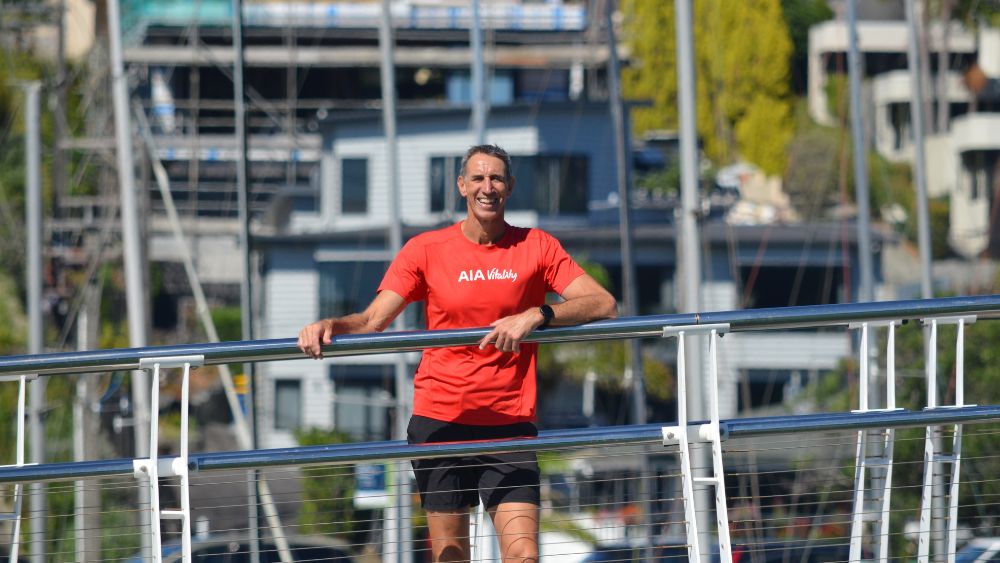





For many Kiwi men, when asked how they are, "Yeah, good, mate" is the default answer, even when things are far from good. AIA NZ’s Claims Compass found men aged 40 to 59 make the highest number of claims for poor mental health of any group, a reminder that the “Yeah, good, mate” generation often isn’t. Much-loved Kiwi broadcaster and AIA Vitality Ambassador Jason Gunn opens up about the times he hasn't been okay, why so many men struggle to say it out loud, and simple ways we can all look out for our mates.
We inherit what we know
I was pretty lucky with my home environment. Growing up in Christchurch, our Sunday family drives were full of chats and laughs, and I was allowed to be my quirky self. If I was sad or angry, I could say so. Although, school was a different story. I didn't play rugby and I did drama, so I was put in a certain box. You learned to be funny, because if you couldn't make the bully laugh, you'd better be able to run. Humour became a skill that kept me safe.
So many Kiwi men in my generation, grew up in homes where you just didn't share how you felt, and I believe that gets passed down. Thankfully, times are changing. Young men are increasingly allowed to say, "actually, I'm not okay." But we definitely still have more work to do in supporting the men around us.
Not every day is my best day
When you've spent years on the screen in people's living rooms grinning from ear to ear, shouting, "G'day, guys!", that's the version people expect at the supermarket. No one's come to watch the darker, sadder show. But like everyone, not every day is my best day, and that's totally fine. In my mid-20s, stress and anxiety showed up in physical symptoms. At one point I couldn't get on a plane, and one day I had to stop the whole Son of a Gunn studio because I was in so much pain.
That was the first time I really said to someone, "I'm not coping." They introduced me to meditation and calming my nervous system, and it helped. Even at 57, those feelings still pop up occasionally, I've just started seeing someone about it again. Sometimes we think we're too much of a problem. But there are people who help with exactly what you're going through every single day. Once you realise that, you think, "I am not helpless and I am not alone”.
Go shoulder to shoulder
For a lot of blokes, to sit opposite a man at a table and ask him how he's feeling, is tough. But put him in the car, on a bike ride or on the golf course, where you're both looking out and doing other things, and you'll often have the best conversations.
Years ago, I was coaching some young Crusaders players in a hotel room, and it was like getting blood out of a stone. So we went out to the field to throw a ball around, and suddenly they were telling me all sorts of stories. Take your mate somewhere they feel comfortable, whether it's a favourite walk, a drive or the local park, and see what happens.
"You've got this, and I've got you"
When someone close to me is struggling, I tell them you don't need to have the answers today. You're not the first person to walk this path, and you're not alone. We can work out the how together.
Then the most important part: listen. We're so used to saying, "How are you, mate?" and not sticking around for the answer. Ask a question, then ask more. "Tell me more. How does that make you feel?" If they say they're okay, let it sit for a moment and gently ask, "Are you honestly okay with that? Because I don't think I would be."
I call it listening to understand, rather than listening to respond. Put your mobile down, turn your whole body towards them, and let them know with a nod or a smile that you're right there. When people realise you genuinely want to know, you'll see their face change.
Notice the change, then knock on a different door
The signs are often quiet. Look for change: a mate who's gone quieter than usual, or one who's trying a bit too hard. If you notice a pattern, it's okay to simply open the gate. It doesn't need to get heavy.
A text can be really powerful. Something like: "Hey mate, it's probably just me being oversensitive, but you seemed a bit quiet today. If you ever want a chat, the coffee's always on." A 15-second video message saying the same thing is even better.
If they brush you off, don't keep knocking on the same door. Try a different one. I've left a Cookie Time cookie on a doorstep with a note saying I'm here whenever they want a coffee to go with it. They might still say they're fine. But wouldn't you rather know you tried every door?
You can't hand out food from an empty picnic basket
My friend Lana said that to me once, and it stuck. Supporting someone takes a lot of energy, so you have to look after yourself too, whether that's sleep, exercise, meditation or time outside.
In our family, we hold each other to that. Ask one of us how we are and "fine" isn't an acceptable answer (try again!). My kids will even ask me, "What are you doing for you today, Dad?" When I'm feeling overwhelmed, I ask myself what I've put in place to stop feeling that way. More often than I'd like to admit, the honest answer is nothing. That's a good place to start.
One thing you can do this November
You don't have to solve the world. Just turn up. Book in some quality time, or do something a bit whacky to change the pattern. "We're going to Clip 'n Climb." "I hate heights." "So do I. Deal with it."
Send a gratitude text to a mate, your dad or your son. "Random, but I just wanted to say how much I appreciate that you've always got my back." You might get an "Are you drunk?" in reply. That's fine. Tell them you just don't say it enough.
I'm not an expert, and I'm still trying to get my own act together. When I'm telling you this, I'm telling myself too. But if just one person reads this and picks up the one thing they needed, well, that's that job done.
Where to get support
If you or someone you know needs to talk, free support is available 24/7:
- Need to talk? Free call or text 1737 to speak with a trained counsellor
- Lifeline: 0800 543 354 or free text 4357 (HELP)
- In an emergency, call 111